Treating my house like a production system
Notes from running a homelab and a family with the same brain.
At work I’m a Site Reliability Tech Lead. The shape of the job is roughly: keep important things running, find the toil that’s eating people’s afternoons, and build the platform that means we don’t keep solving the same incident twice.
At home I do a quieter, sillier version of the same thing.
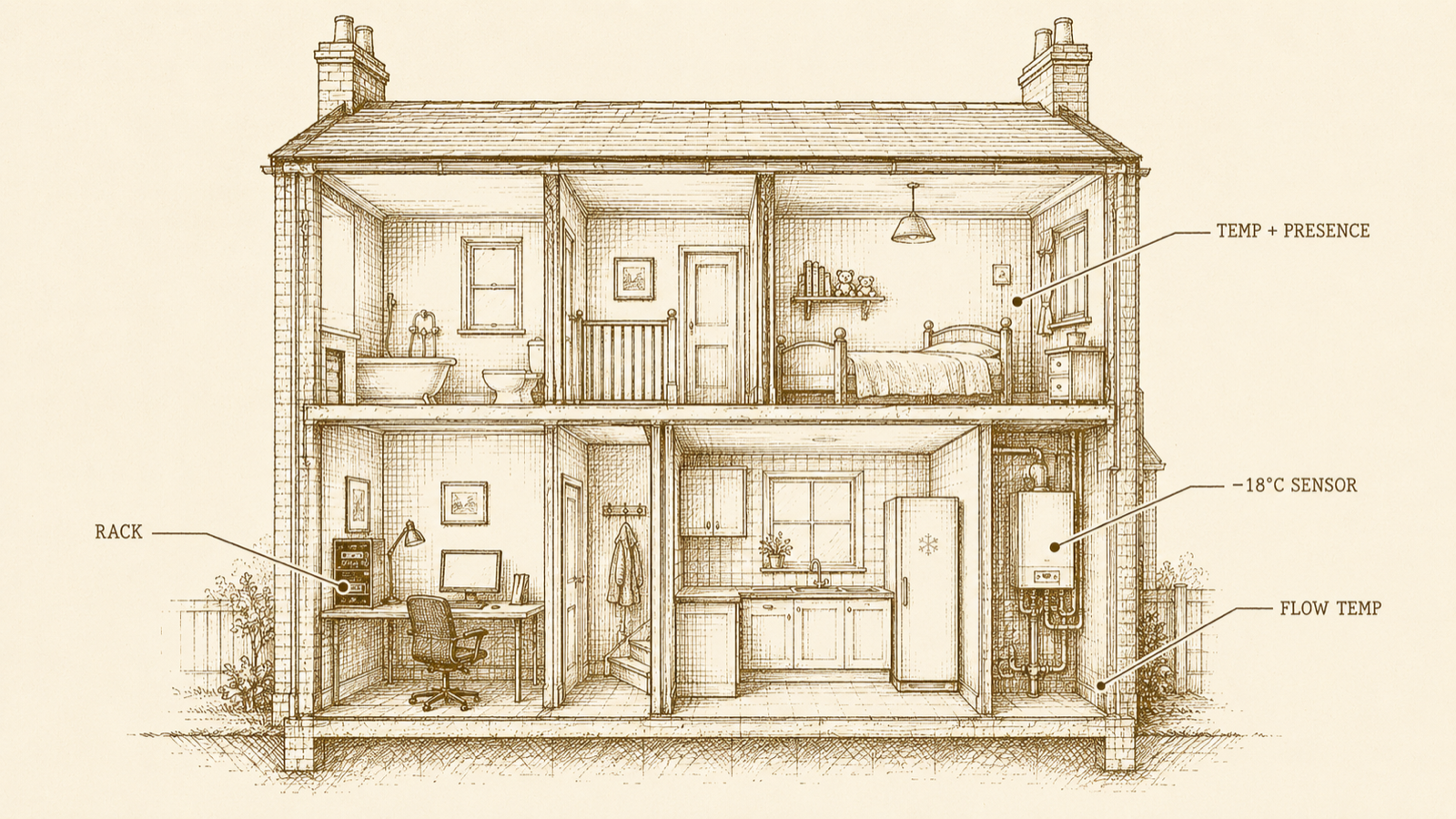
There’s a homelab in the corner of the office, a Home Assistant install with a few hundred entities, an agent runtime called OpenClaw (I didn’t write it — I run a fleet of agents on it), and a stack of automations that mean lights, climate, energy, presence and a few medical reminders happen without anyone thinking about them. None of it is impressive in isolation. The interesting bit is the shape of the operation.
“Production-shaped” at home§
When I say I treat the house like production, I don’t mean I run a NOC out of the spare room. I mean I notice that a few habits from work make domestic systems noticeably better:
- It’s observable, or it isn’t real. If a thing only runs because I’m watching, I haven’t built anything. The freezer has a temperature sensor. The boiler has flow temps. The 3D printer publishes job state into MQTT. If I can’t see it, I can’t trust it.
- It’s recoverable, or it’s a liability. Backups exist, off-site, on a Raspberry Pi I keep in another building. I’ve actually restored from them. Twice. Not a drill.
- It’s documented to the point of boring. Home Assistant automations have comments. Skills repos have READMEs. The “why” lives next to the “what.”
- There’s an on-call rota of one. That’s me, all the time. I make peace with that by making sure the system pages me only when it actually matters.
- Changes go through a changelog. Not because it’s important, but because future-me forgets everything by Tuesday.
Five things that ported over from work§
SLOs, but for the family. I don’t publish error budgets to anyone in the house. But internally I think in those terms. The lights working when you walk in the front door is a 99.x SLO. The freezer alert firing within two minutes of the door being left open is a 99.9 SLO. Everything else is best-effort. Naming the tier stops me over-engineering the trivial bits.
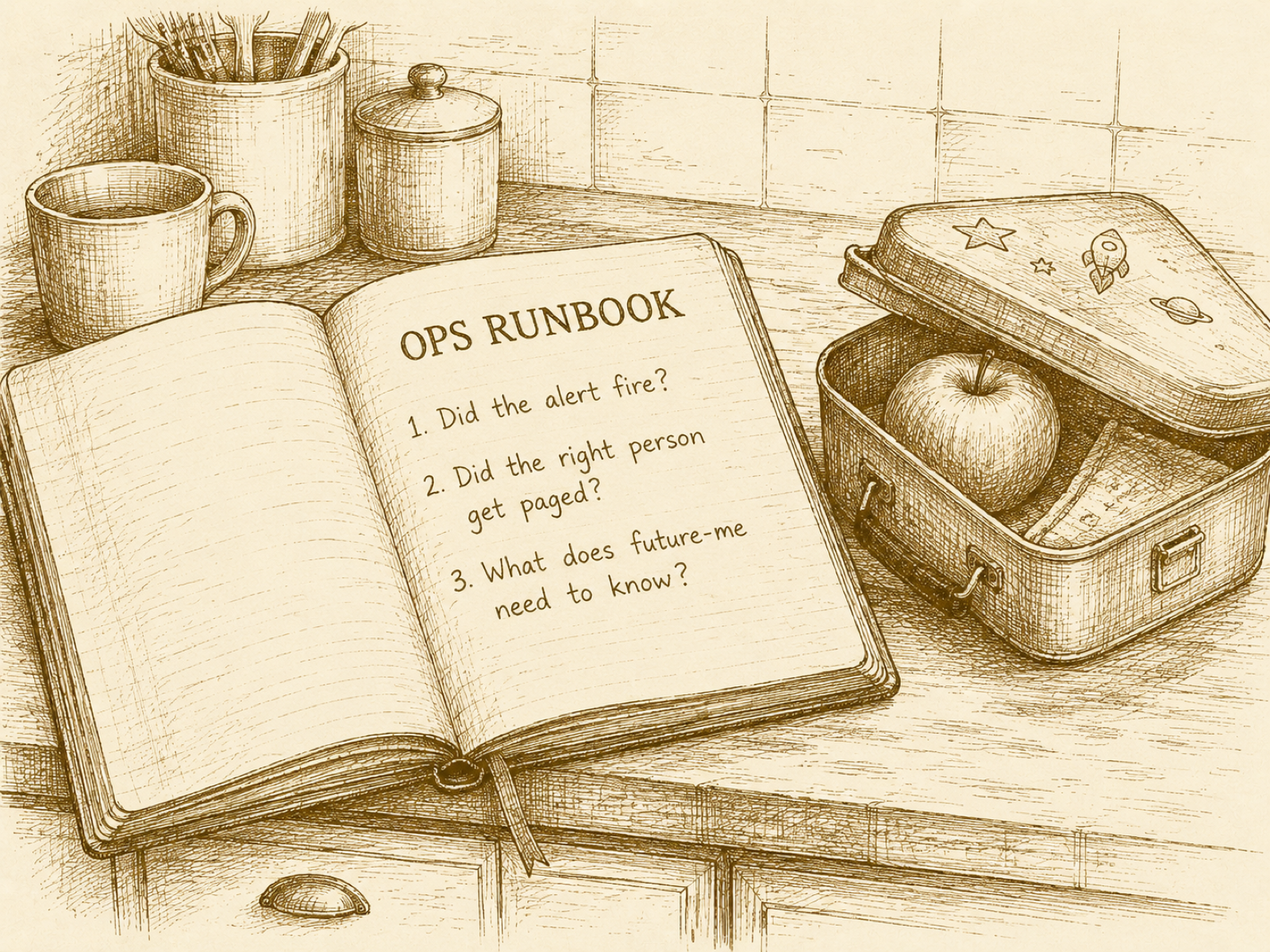
Runbooks live next to the system. When the internet falls over, there’s a printed card on the rack that says what to power-cycle in what order. My wife has used it more times than I’d like to admit, which means it works.
Postmortems, properly. The time the freezer alarm didn’t fire, I wrote it up. Three lines. Cause, fix, follow-up. The follow-up was “alert if the sensor itself goes quiet for more than 30 minutes.” That alert has saved me twice since.
Vertical slices, end-to-end. A telemetry pipeline isn’t done when the metrics land in a database. It’s done when I’m actually looking at a dashboard while I make a decision. Same rule at home as at work — if no one is using the output, I haven’t shipped the thing.
Kill it if the cost shows up. I rolled back a DNS-level ad-blocker mid-deploy when the realities became clear — single point of failure, IoT devices that bypassed it anyway, support overhead for a household of non-engineers. Replaced it with a one-line change at the router. Closed the ticket. Better to walk away cleanly than nurse a half-useful service forever. There’s a longer write-up of that one.
What doesn’t port over§
A few things from work don’t translate, and it’s worth being honest about that.
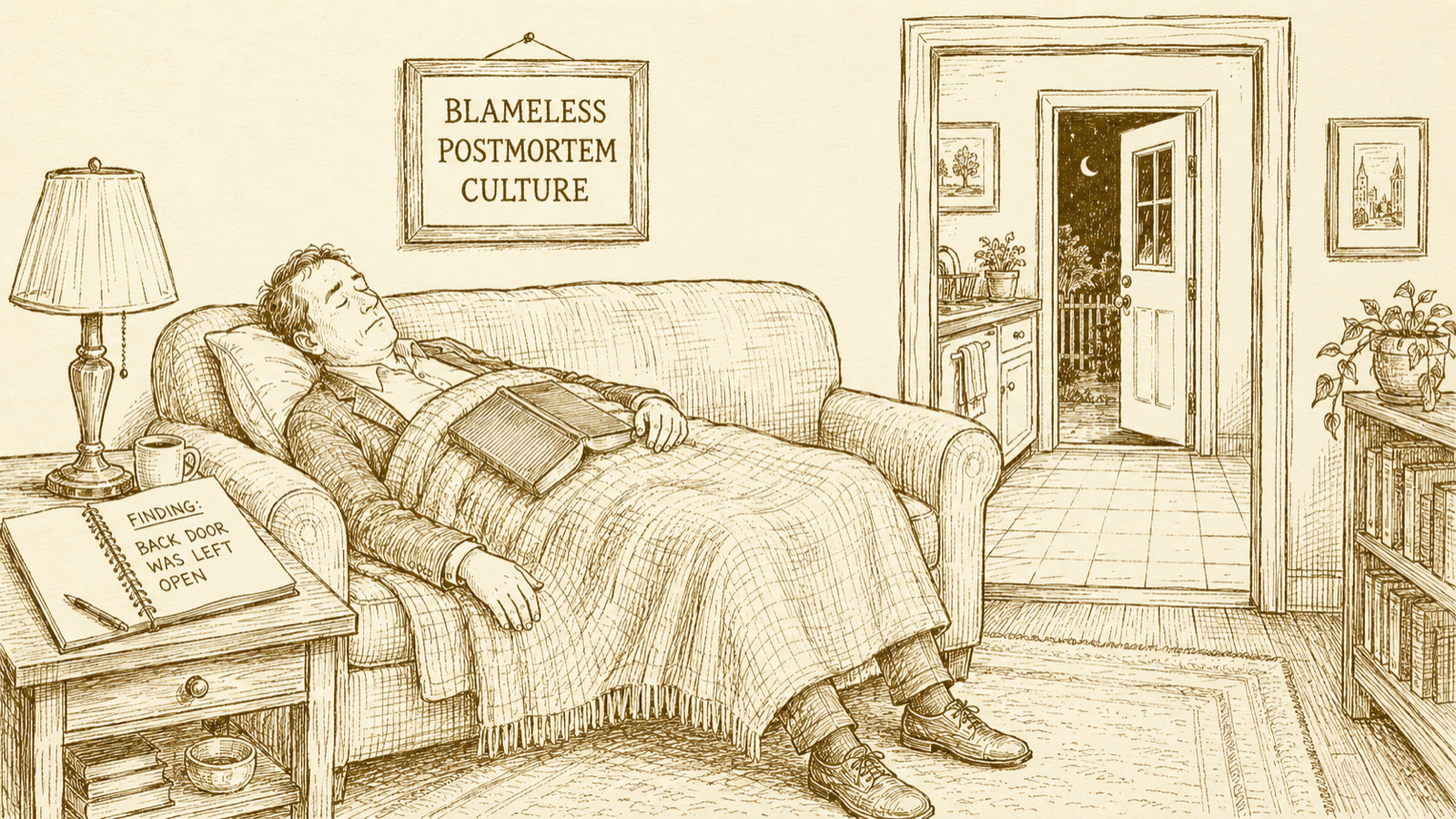
Blameless culture is awkward when the blame is your spouse. “It looks like the back door was left open” is technically a postmortem finding, and also technically grounds for sleeping on the sofa.
“Scaling” doesn’t really apply. There’s exactly one house and four people in it. Throughput isn’t going up. The interesting axis is toil, not load.
And the honest one: most of this discipline is for me, not for the family. They want lights to work and warnings if the freezer’s defrosting. The structure is what stops me getting bored and breaking things on a Tuesday night.
Why I bother§
Two reasons.
One: at work, the muscle that catches a bad rollout early is the same muscle that catches a bad weekend project early. Keeping it warm at home means it’s warm on Monday.
Two: there’s a particular flavour of contentment in a system that quietly does the right thing for months. The lights come on. The car charges overnight. The 3D printer alerts me when it’s done. My son’s coach agent gently nudges him about carbs before football. Nothing impressive, all the time.
That’s what the rest of this site is about. The builds, the breakages, the rollbacks, and the patterns that survive contact with real life.